
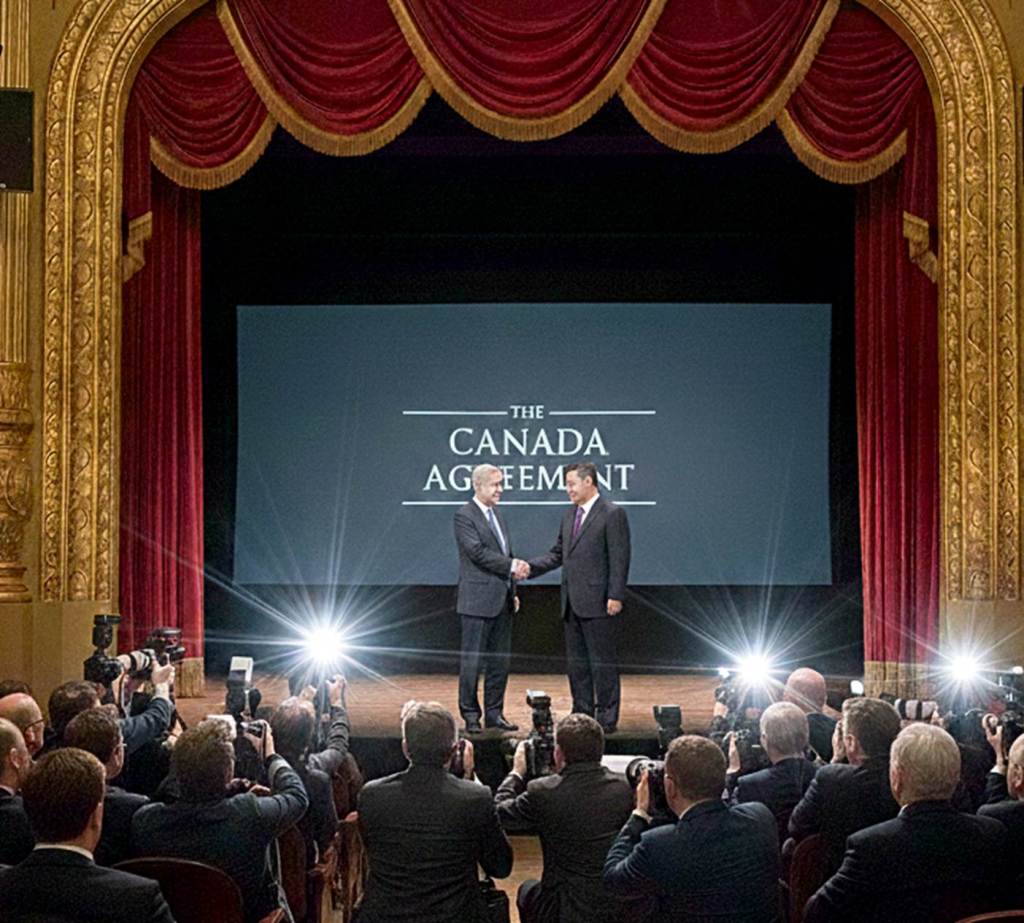
In the high-stakes world of international trade there is a fundamental difference between a contract and a conversation. The Canada-United States-Mexico Agreement (CUSMA), is a binding legal agreement that dictates how three nations behave, under threat of severe penalty. A conversation on paper is what Prime Minister Mark Carney just brought back from Beijing. But the way he represented it I would call “Agreement Theater”: leather portfolios on signing desks as stage props, with the actors’ big smiles during the signing ceremonies, followed by more smiles during the ritual handshakes.
Yet, listening to the Prime Minister’s Office and the excited reporting from much of the media, you would think Canada had just signed a second CUSMA with China. But if you look past the velvet curtains on the theatre stage, and the video cameras in front, what you find is not a binding trade agreement, but a list of Canada’s expectations, and commitment to more dialogue.
The Script of the Play
In a theater the props don’t have to be real; they just have to look real for the audience. This is precisely how the Carney government is presenting its “new Strategic Partnership” with China, and its several Memoranda of Understanding (MOU).
To the average Canadian voter an MOU sounds like a real deal, a trade agreement celebrated with a handshake. But look at the text of the documents signed in Beijing, particularly the Joint Statement. While the PM’s press release used the word “secured” to describe new market access for Canadian goods, the actual legal text contains the ultimate trap door: “”The sides commit to advancing…”. This is about advancing in future, not agreeing at present.
CUSMA vs. The Beijing Roadmaps
To understand why this script is fundamentally misleading, compare the Joint Statement with a real treaty like CUSMA.
When Canada signed CUSMA it was not merely an intent to cooperate. It was giving up specific portions of national sovereignty in exchange for legal certainty in trade. CUSMA is hard law. If Canada violates the rules on automotive parts, the US can take us to a binding dispute panel and legally impose retaliatory tariffs. CUSMA has a “shall” and a “must” on many pages.
Compare that to what Canada just signed with Beijing. The “expected” reduction in China’s tariffs on Saskatchewan’s canola may never materialize, or may last only a short time. We cannot sue, or appeal to a panel. We can only consult.
The media presented the achievement as a firm deal for Canadian oil and LNG exports. But it merely commits to “strengthening exchanges at all levels” and to strengthen bilateral economic relations. It is a collection of aspirations that can be ignored the moment a political whim changes in Beijing. If China decides tomorrow to buy its oil from Russia instead of Canada, we have no legal recourse for our expectations not being sustained.
The Davos Disconnect
Prime Minister Carney’s performance at the World Economic Forum in Davos was remarkable. Speaking to the global elite, he lamented the “end of the rules-based order” and called for “principled pragmatism.” He argued that middle powers must band together to avoid being “on the menu” of great powers.
It was a compelling speech, delivered with the polished authority of a former central banker. But it cannot justify a cynical domestic strategy. By using MOUs and dialogue instead of a binding agreement, Carney is providing a performance that avoids the accountability of the very democratic institutions he claims to protect. Because these China arrangements are not binding treaties they do not require a vote in the House of Commons. They do not face the scrutiny of parliamentary committees. They allow the Prime Minister – much like the US President – to conduct foreign policy by personal decree, issuing a ‘roadmap’ that has all the aesthetic of a trade deal but none of the substance, or the democratic accountability. It is a way to look strategic and successful without having to defend a real, legally binding – but politically risky – “Strategic Partnership” with Beijing.
The Cost of the Illusion
We have been here before. We saw it with the canola disputes of the last decade, where China used “phytosanitary concerns” as the excuse for political coercion. Treaties provide a shield against that coercion; MOUs provide a media release. To imply that a Food Safety MOU signed in 2026 will prevent the Chinese Communist Party from using trade as a weapon in 2027 is naive.
Furthermore, this theater creates a dangerous friction with our actual, binding trade partners. In 2025 The US purchased approximately 75% of our exports; China just 4%. As we approach the 2026 CUSMA review, the Trump administration is angrily watching Canada’s presentation of its strategic pivot to China. We are risking our most important trade relationship for the theatrical “alignment” with a state that makes it clear, in the Joint Statement, that dialogues aren’t promises.
Conclusion
Mark Carney understands the value of a contract. Yet, as Prime Minister, he is asking Canadians to bank our economic future on a series of non-binding handshakes.
It is time to recognize this for what it is: Agreement Theater. It is a performance designed to provide political credit for effective trade diversification without having the ability to negotiate and sign a real treaty with real benefits. Canada deserves a trade policy built on the hard reality of law, not the flickering shadows of a Beijing photo-op. If Canada doesn’t have the economic clout to negotiate such a real deal let’s at least be honest about it, and not pretend that we can.
If an agreement isn’t binding it’s just a script in a play. And eventually, the curtains will come down on the stage.
Discover more from Andrew's Views
Subscribe to get the latest posts sent to your email.
Categories: Uncategorized
 Andrew's Views
The question is whether the “theatre” will advance or inhibit better relations with the US. Which is to say, whether the “bluffing” engaged in by Carney will be helpful or not. Moreover, as you will know: bluffing and posturing is a part of the negotiation game. As Trump himself knows very well.
LikeLike
In a procurement context, an American colonel once said to us, “Contracts and conversation: if you don’t have the one, all you have is the other.” It applies to many facets of life, as well as to the Agreement Theatre you’ve dissected here.
LikeLike
I agree. We saw another recent example in the MOU with Alberta re a potential for a new bitumen pipeline.
LikeLike