
“The era of global warming has ended; the era of global boiling has arrived.” – UN Secretary-General António Guterres, July 27, 2023
Introduction
Prime Minister Mark Carney has promised to make Canada an “energy superpower.” That promise raises different hopes: for Alberta, more pipelines and ports; for net zero advocates, no pipelines, more wind and solar. Whose hopes will be dashed? We’ll see when Carney reveals his plan.
But hovering over every big energy policy is a dark cloud: climate anxiety. Canada’s Mental Health Commission has written about “Understanding and Coping with Eco-Anxiety”. Politicians and the media fuel anxiety by telling Canadians that climate change is an “existential crisis,” a “climate emergency,” even “global boiling.” Yet the UN’s own scientific reports don’t use that extreme language anywhere.
Canada’s governments have spent billions to “fight” climate change, without changing our climate at all. For example, as Heather Exner-Pirot has explained, Canada’s emissions cap and industrial carbon tax are fantastically expensive, yet have no measurable effect on Canada’s climate or weather.
Climate change is real, but its dangers are wildly exaggerated, and its benefits—yes, there are benefits— are rarely mentioned. Let’s ignore the scary noise and calmly look at the facts. Here are 10 misconceptions that can fuel eco-anxiety —and some reasons to be optimistic about our future.
- Did the Industrial Revolution Really Cause Global Warming?
The usual story: humans burned coal, the world warmed, and everything got worse. But Earth’s warm-cold climate swings are nothing new. The Little Ice Age (1300–1850) brought famine and hardship; the Maunder Minimum (1645-1715) brought deadly cold. The planet emerged naturally from the Little Ice Age, starting around 1850. What is the cause and what is the effect? Some historians argue that it was the planet’s natural warming in the 1850s that made the Industrial Revolution possible. Farming improved, life expectancy rose, and societies finally had the resources to invest in industry.
Geological records show dramatic swings in Earth’s temperature, dwarfing anything seen recently, but historical CO₂ variations do not correlate with the hot and cold temperature trends. Today, there’s no way to know how much less warming would have occurred without the Industrial Revolution.
2. Is Climate Change an Existential Crisis?
Sensational stories often link climate change to supposedly more extreme weather, but the UN’s Intergovernmental Panel on Climate Change (IPCC) and many independent scientists find that climate change is not causing more extreme weather. IPCC’s science studies find no clear, consistent connection to increased hurricanes, floods, or droughts outside natural variability.
Recent warming has mostly meant slightly milder winters, not summers hotter than in the 1930s. This is crucial because cold kills far more people than heat. An Our World in Data study concluded that globally, cold-related deaths are about nine times higher than heat-related deaths. Even in the world’s warmest regions, cold is still the bigger killer. Slightly warmer winters have saved thousands of lives.
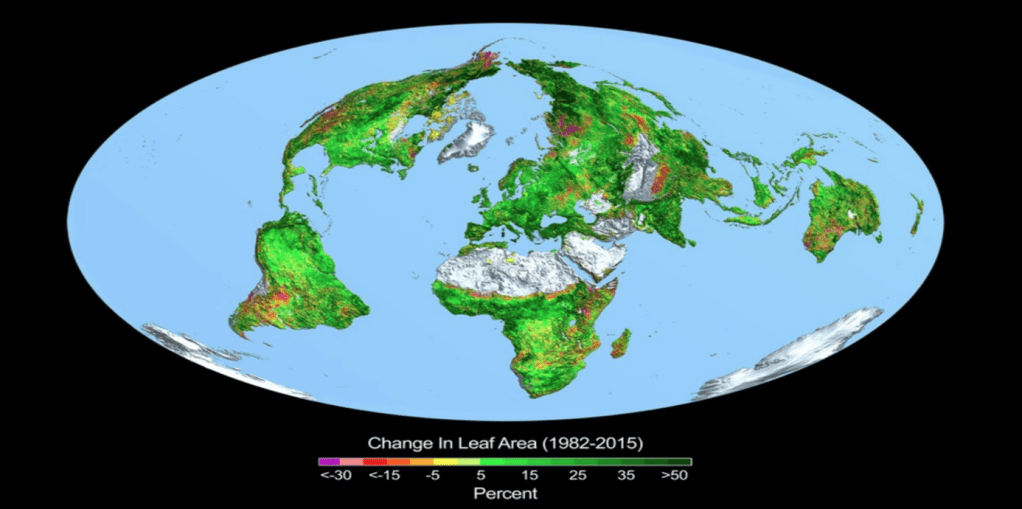
A major overlooked benefit of more CO₂ is a greener planet. NASA satellite images show between a quarter and half of Earth’s vegetated land has become greener in the past 35 years—mainly due to CO₂’s fertilization effects on plant growth. The new leafy area is about twice the size of the continental U.S. This means higher crop yields, healthier forests, and shrinking deserts. Should we continue spending billions to fight this?
The photo below represents the greening up to 2015. There would have been more greening by 2025.
3. How Much CO₂ Causes How Much Global Warming and Climate Change?
CO₂ does cause some warming, but its effect tapers off rapidly as concentration rises, so each new unit of CO₂ has a smaller impact as it approaches saturation. Most climate models agree on this diminishing effect.
Natural sources—plant respiration, ocean outgassing, decay—emit over 750 billion tonnes of CO₂ yearly; humans emit about 36-38 billion tonnes, or 5%. But water vapour is a much stronger greenhouse gas than CO₂. Its effects depend on temperature, wind and clouds, which are strongly affected by solar activity.
Changes in solar radiation, over which humans have zero influence, strongly affect clouds and global temperatures, over centuries and millennia. Solar cycles, cosmic radiation and Earth’s orbital changes have played enormous roles in climate history, dwarfing the 5% of human-caused CO2 emissions.
4. Is Climate Change Causing More Extreme Weather?
Media often headline the “hottest day on record” or “record breaking wildfires”, but even the IPCC admits that, for most extreme weather, there’s no clear climate change signal beyond normal variability.
However, our ability to cope has improved dramatically. Global deaths from natural disasters have plunged 90–98% over the past century, even as world population quadrupled. Better infrastructure, early warnings, cell phones and emergency response mean far fewer lives lost. This is good news, seldom reported.
5. In the Paris Agreement Did All Countries Pledge to Reach Net Zero By 2050?
The 2015 Paris Agreement is often described as a global pledge to cut emissions to limit warming to 1.5°C. That’s wrong. It lets each country set its own non-binding targets. Major emitters like China and India pledged to keep increasing their emissions into the 2030s.
Since 2015, few countries are on track to meet their voluntary targets. Canada aimed for 40–45% below 2005 levels by 2030, but by 2023 our emissions were estimated at just 8% lower. How likely is hitting that 40–45% target in just five years?
6. Is Canada Warming Twice As Fast As the Average?
The scary story that Canada is warming “twice as fast as the average” is misleading. It implies that “the average” means the average of other countries. But “average” means the average of the planet, of which 70% is ocean, 30% land. Oceans warm slowly; the land, especially at higher northern latitudes, warms much faster. That’s why every country is warming twice as fast as the average of the ocean plus land.
7. Are Canada’s Emissions Causing Canada’s Climate Change?
No. It’s a common fallacy that Canadian CO₂ measurably warms Canada’s (or a province’s) climate. But CO₂ doesn’t stay above where it’s emitted. It circulates globally.
Canada’s emissions are just 1.5% of the world’s total human emissions; the other 98.5% comes from elsewhere. And human emissions are just 5% of the total. That’s why Canada’s change to Canada’s climate is immeasurably small.
This matters for the increasing frequency of climate litigation claiming that Canada’s energy industry (apart from wind and solar) and pipelines are worsening Canada’s climate. Because there’s no causal connection between Canadians’ emissions and Canada’s climate these lawsuits have no factual basis, and should fail. Also, as Canadian courts can’t control the 98.5% of the emissions from other countries, any order a court might make would serve no useful purpose.
8. Are Wind and Solar Replacing Fossil Fuels in the Green Transition?
What green transition? Fossil Fuels continue to underpin the global energy system, supplying 86% of the world’s energy needs.
Canada still gets 76% of its primary energy from fossil fuels. Wind and solar can only generate electricity, and electricity is just 18% of Canada’s energy mix. Wind and solar together provide only 8.4% of our electricity generation. According to this Canadian government report the 2024 contribution to Canada’s overall primary energy by wind was only 2-2.5%; solar, 0.1-0.3%. That’s not much of a transition.
Renewables advocates often claim wind and solar are now cheaper than fossil fuels for generating electricity. That might be valid if Canadians used electricity only when the sun is shining and the wind is blowing. But wind and solar are weather dependent, requiring full backup, especially at peak demand times (usually with natural gas). This duplication increases costs and reduces reliability, risking blackouts.
As a Bank of America study reported, “… Solar and wind look more expensive than almost any alternative on an unsubsidized basis when accounting for those external factors … .” [i.e., backup costs]
In Ontario, Parker Gallant has shown that wind generation frequently occurs when demand is low, forcing Ontario to sell the surplus generation to adjacent Canadian provinces and US states at a huge loss, or pay generators to shut down. When demand is high but the wind is not blowing, Ontario becomes an importer of high cost electricity. That’s why Ontario’s electricity rates have so escalated that successive governments have concealed the real price with taxpayer-funded rebates to consumers.
Rapid price spikes in countries pushing hardest for renewables have sent investment and employment to China, which uses much more coal. The result is both higher costs at home and higher emissions for the planet.
9. Will The Green Transition Create Many New Green Jobs?
Again, what green transition? Western governments promise “clean green jobs,” but don’t define “clean green”. In the U.S., jobs in used bookstores and antique dealers were absurdly counted as “green” because they involved recycling: https://www.youtube.com/watch?v=q0IQ_vI9WZ0
A 2025 Natural Resources Canada program evaluation found two major federal climate programs demonstrably delivered neither new jobs nor lower emissions, after seven years and $300 million spent. The managers even stopped collecting performance data throughout the project duration.
If green tech were as profitable and job-creating as advertised, it wouldn’t need massive government support to survive.
10. Will Our Government Soon Make Canada a Green Energy Superpower?
“Energy superpower” is a great slogan but it is undefined – a Rorschach test. Those who think it means more pipelines are likely to be disappointed.
Even if some of our impact assessment processes are accelerated or waived, it still takes at least a decade to plan and construct any major pipeline. A decade is optimistic if the pipeline is to go through non-consenting provinces and to be accepted by all potentially affected First Nations. A major timing concern is the ever-present blockades and litigation. Multiple court cases with unpredictable court decisions create major uncertainties that deter investment. This happened with the Trans Mountain Pipeline Extension, when its owners walked away from their project even before the final court decision. Then Ottawa purchased and completed it.
To those who think “energy superpower” means more wind and solar, you may be partially right because federal and provincial government policies have provided massive subsidies for these technologies, to assuage climate anxiety. However, with today’s unprecedented federal and provincial deficits and debt, on top of US tariffs and Canada’s commitment to increase its military spending to 5% of GDP by 2035, money for increased subsidies is likely to be limited.
Conclusion
In bygone centuries people danced to the rain gods to bring rain. Today, some believe the dance of Canadian carbon taxes and renewables subsidies can stop extreme weather in Canada. Homo sapiens is a superstitious animal.
The climate misunderstandings above have led to unaffordable climate policies with no measurable benefit. Let’s base our environmental policies on evidence, not eco-anxiety.
What policies should Canadians—and Prime Minister Carney— support?
The theory that CO₂ is the primary driver of Earth’s temperature today is unproven and probably wrong. Natural factors —solar output, earth’s orbital changes, cloud activity — play huge roles.
We have always faced extreme weather and always will. The IPCC’s scientific reports don’t support the relentless drumbeat of catastrophe. Extreme weather is no more frequent, and far less deadly, than before. The planet is getting much greener, with slightly warmer winters.
Most climate policies have no measurable effects on global emissions or Canadian jobs, and come at far higher costs than politicians admit. Instead of pretending we can “fight” climate change, government should focus on real problems:
- Protecting vulnerable communities from natural disasters
- Removing barriers to building effective infrastructure
- Reforming laws, subsidies and taxes that unfairly penalize essential energy sources
We don’t need to sacrifice happiness or prosperity out of climate panic. Canada’s best days are still ahead—if we keep perspective, stay calm and focus on real solutions to real problems.
Discover more from Andrew's Views
Subscribe to get the latest posts sent to your email.
Categories: Carney, Climate Change, climate crisis, Crisis, Deaths, Electricity, Emergency, Energy, Government, Impact Assessment Act, Judges, Law, misinformation, Paris Agreement, pipeline, politics, Prime Minister, Science, Uncategorized
 Andrew's Views
Ya, but then there would be nothing for the news cycle……..
LikeLike
Great summary of the mess so many governments have created and nicely outlined in the 10 “misconceptions” you have listed! Far too many politicians believe they can see the future from picking industry winners to actually believe they can change the climate!
LikeLike
The most powerfully forces in human history are mass delusions fueled by irrational fear combined with imaginary collective guilt.
LikeLike
The most powerfully forces in human history are mass delusions fueled by irrational fear combined with imaginary collective guilt.
LikeLike