
I have great respect for Canada’s Supreme Court, their long hours of work and the difficult decisions to make. Even if I might have decided a case differently, I usually find its judgements reasonable. But its Carbon Tax Decision is an exception. What the Majority Justices said about the constitutionality of the carbon tax isn’t worrying; what they went on to say, unnecessarily and wrongly about climate change, is a major concern for the future of Canadian law.
This federal-provincial constitutional dispute was heard through a special abbreviated procedure: a reference case, in which a constitutional issue goes straight to an appeal level court without a trial or witness evidence. Reference cases are decided on an agreed set of facts.
In this case the Majority of the Court’s Justices reached a reasonable conclusion: that the legislation establishing the carbon tax fell within the federal government’s constitutional authority. However, the Majority then damaged its position by making several unnecessary and incorrect collateral comments about climate change. These comments will be harmful for future cases.
The results of these significant errors are already apparent. They have sparked unwarranted “climate crisis” litigation that treats the Majority’s factual errors as binding precedents. It may take years for a subsequent Supreme Court decision to undo the damage.
Let’s look at what the Court got right, and wrong.
What the Court Got Right
All three provinces challenging the carbon tax law conceded that climate change was a serious problem that most countries have agreed to address through international efforts. Without a world government, the only level of government that could effectively address global emissions is a national government, not subnational units like Canadian provinces. Therefore, as both Ottawa and the three opposed provinces agreed that climate change was a global concern, it was within the constitutional authority of Ottawa to legislate minimal standards for this national decarbonization effort. Given the opponents’ concessions the Majority got that right.
What the Court Got Wrong
Described below are three embarrassing fallacies in the Majority’s collateral comments. For a more comprehensive critique of these errors, read Jack Wright’s article, How Canada’s Highest Court Got Climate Change Wrong.
The Majority’s collateral comments were a collage of confusion. Unfortunately, climate advocacy groups are wrongly treating these collateral comments as binding precedents in new climate litigation, and lower courts are starting to show some sympathy for these arguments.
For example, in Mathur v. Ontario the trial judge described the applicants as :
“seven young Ontarians between the ages of 15 and 27. They are remarkable youth and young people who have demonstrated a longstanding commitment to fighting climate change …. .”
The applicants have asked the court to set aside Ontario’s legislated targets for reducing CO2 emissions as being inadequate, and also, a violation of their constitutional rights. They seek an order to require the Province (i) to implement more stringent reduction targets and (ii) to revise its climate change plan to achieve the new targets. Presumably, if these children are not satisfied with Ontario’s revised target, or its plan to achieve it, they can return to court to seek more stringent orders.
Thus, unelected judges rather than elected representatives will be setting climate policy such as higher energy prices, on the application of unelected minors and youth, thanks to the Carbon Tax Decision. And that’s just the beginning.
The Mathur trial judge wrote that:
[17] …. the majority’s decision [in the Carbon Tax Case] contains a useful summary of background facts with respect to GHG and climate change, as well as a number of statements and findings that are relevant to this case. ….
She treated these “facts” and “findings” as precedent, and quoted at length from the Majority decision.
Collateral Comment 1: The Carbon Wall Fallacy
In an obvious contradiction, the Majority first stated that it is
“an uncontested fact that the effects of climate change do not have a direct connection to the source of GHG emissions (paragraph 187).
Only eight paragraphs later it contradicted itself. In paragraphs 195 and 198 it stated that severely harmful effects of CO2 “pollution” will mostly be caused by, and harm, those residents closest to the geographical origin of those emissions.
[195] …. In other words, this is a true interprovincial pollution problem of the highest order. This Court’s decisions have consistently reflected the view that interprovincial pollution is constitutionally different from local pollution and that it may fall within federal jurisdiction on the basis of the national concern doctrine …..
These unnecessary comments assume that there is, in effect, a physical CO2 wall around Canada, resulting in grave harm to other provinces if any province fails to set sufficiently stringent decarbonization requirements. Of course there are no CO2 walls anywhere. Unlike local emissions of contaminants like sulphur dioxide or particulates, CO2 molecules emitted in China or India, or evaporating from the oceans, flow over all of Canada and all around the planet. The idea that local CO2 emissions cause harmful local or interprovincial climate change is a fallacy. The Majority got that wrong.
This gives the impression that different people wrote paragraph 187 and paragraphs 195 and 198, and that they didn’t check with each other for consistency prior to publication.
If the opposing provinces had properly informed the Court on this issue the Court would have realized that 98.5 percent of the impact of climate change from CO2 in Canada comes from outside Canada. That’s because Canada represents only 1.5% of global emissions, and each province, only a fraction of that. If Canada ceased to exist tomorrow its eliminated emissions would quickly be surpassed by the continually increasing emissions from the two thirds of the global population living in developing countries.
Collateral Comment 2: The Warming “Twice as Fast as the Global Average” Fallacy
The Majority wrote:
[10] The effects of climate change have been and will be particularly severe and devastating in Canada. Temperatures in this country have risen by 1.7°C since 1948, roughly double the global average rate of increase, and are expected to continue to rise faster than that rate. …..
This “twice as fast” scare originated in a Canadian government report claiming Canada is “warming twice as fast as average”. But many other countries also had the same “twice as fast” headlines, e.g.: Australia, Finland, China, Sweden, Russia, Britain, all of Europe, Singapore and Japan. How can every country be warming twice as fast as the average? (My detailed explanation is here.)
It’s only possible because of the deceptive use of the word “average.” The story is not that any country is warming twice as fast as the average of every other country. Rather, it is that the country is warming faster than the average temperature of the entire planet. But the entire planet is not just the land surface, it is the land and the oceans. And the Earth’s surface is 30% land and 70% ocean.
According to NASA, from 1881 to the present the ocean surface has warmed about 0.6 C, while the land surface has warmed about 1.8 C. Using the 30/70 distribution of the Earth surface, the weighted average of the two implies combined warming of 1.0 C. That explains why the landmass as a whole warmed at nearly twice the global average. The Canadian Government’s report shows nothing more than that Canada is a land mass, not an ocean. Not scary, just trivial.
It is not true that “the effects of climate change have been and will be particularly severe and devastating in Canada.” The Majority got that wrong.
Collateral Comment 3: The Cause and Effect Problem
The cause/effect discussion starts with paragraph 7, under the dramatic heading The Global Climate Crisis. Even the IPCC does not use the words “crisis” or “emergency” to describe climate change.
[7] Global climate change is real, and it is clear that human activities are the primary cause. In simple terms, the combustion of fossil fuels releases greenhouse gases (“GHGs”) into the atmosphere, and those gases trap solar energy from the sun’s incoming radiation in the atmosphere instead of allowing it to escape, thereby warming the planet. Carbon dioxide is the most prevalent and recognizable GHG resulting from human activities. …
Simple, yes, but this simplicity implies that before humans began to burn fossil fuels there was no climate change on planet Earth. That is wrong.
Throughout the history of the Earth, carbon dioxide emissions have varied up and down significantly but there is no correlation between those levels and average global temperatures. Climate Charts
There is abundant scientific debate about both the rate of climate change to date, its causes, and especially, the estimates of future changes (Clintel, one trillionth of a degree, Why climate models fail) As the IPCC wrote in its Third Assessment Report:
“The climate system is a coupled non-linear chaotic system, and therefore the long-term prediction of future climate states is not possible.”
It is also well established that the warming effect of each molecule of CO2 declines logarithmically as the concentration of CO2 increases.
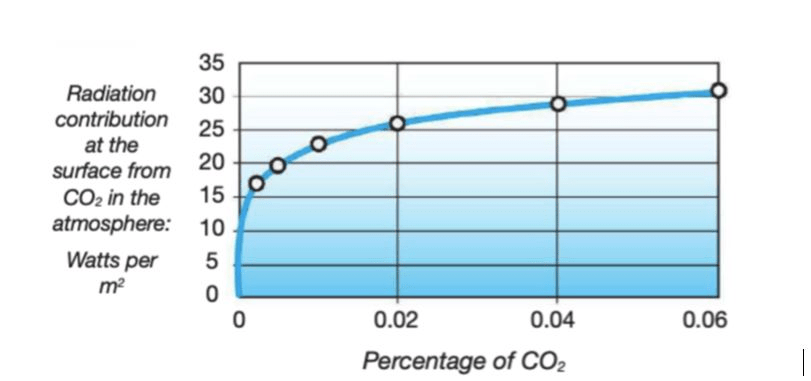
Further increases in CO2 emissions beyond the present near-saturation point will have minimal effect on the earth’s temperature: The Greenhouse Gas Effect, CO2 Coalition, p 15-16.
8] At appropriate levels, GHGs are beneficial, keeping temperatures around the world at levels at which humans, animals, plants and marine life can live in balance. And the level of GHGs in the atmosphere has been relatively stable over the last 400,000 years. Since the 1950s, however, the concentrations of GHGs in the atmosphere have increased at an alarming rate, and they continue to rise. As a result, global surface temperatures have already increased by 1.0°C above pre-industrial levels, and that increase is expected to reach 1.5°C by 2040 if the current rate of warming continues.
The concentration of greenhouse gases in the atmosphere may be alarming to some, but perhaps only because of cherry picking the start date for looking at the increase.
Our planet is a lot older than 400,000 years: actually, billions of years old. Geologists like Ian Plimer tell us that there have been several times in the Earth’s history when the temperatures were much higher than today while CO2 levels were lower, and vice versa.
It is misleading to start looking at planetary warming only at the beginning of the Industrial Revolution when we were coming out of the Little Ice Age. It is also misleading to start looking at emissions and climate from the 1950s, omitting the much higher temperatures measured in the 1930s.
Taken together, these three erroneous collateral comments have weakened the precedential value of what the Court got right.
Conclusion
It wasn’t necessary for the Majority to comment on climate science issues, on which they had neither expertise nor evidence. All they needed to say was that planetary decarbonization requires actions by nation states that individual provinces cannot provide effectively. There was no need to assert that climate change was an existential crisis that threatened humanity, or to assume that it was caused entirely by local or interprovincial emissions of CO2.
A judicial decision is authority only for what it actually decided, not all the other background and explanatory comments. That is why a court’s reasons will normally not go far beyond what is necessary to decide that case, to avoid triggering or affecting future cases. In this case the Majority went far beyond what was necessary or prudent.
Canada has a large group of well-financed environmental charities and lawyers ready to pounce on any judicial encouragement. The Majority’s unnecessary and confusing climate change comments have provided a new key to the courthouse door. Let’s hope the Court corrects this in future by explaining that its collateral comments in the carbon tax reference case were never intended to be binding.
Discover more from Andrew's Views
Subscribe to get the latest posts sent to your email.
Categories: Climate Change, climate crisis, Constitution, Crisis, Environment, Government, Judges, Law, Paris Agreement, Supreme Court, Uncategorized
 Andrew's Views
Canada actually absorbs twice as much CO 2 as it emits according to NASA but I guess those Supreme Court justices chose to ignore that fact!
LikeLike
They weren’t told that by the provincial AGs opposing the federal AG.
LikeLike
It will be interesting to see what the collateral damage will be in Canada from the ‘change in direction’ that is happening in the US. I hope the current Canadian Climate Change narrative is one of the casualties.
LikeLike
I share your hope. Getting rid of the carbon tax is only a small beginning.
LikeLiked by 1 person