
Guest Post By Roger Palmer, P. Eng. (retired)
As solar radiation heats the earth’s surface the earth itself becomes an emitter of infrared energy, radiating it back into space. The earth will slowly heat up until the amount of infrared energy it radiates into space is equal to the amount of energy that is absorbed by the earth’s surface from the sun. If the earth had no atmosphere this “equilibrium temperature” over time would average about -13 degrees C – too cold for comfort! But the earth’s atmosphere raises the equilibrium temperature to an average of about +15 degrees C, making earth habitable. Let’s look at how the atmosphere affects the earth’s average temperature.
The atmosphere consists of air (a mixture of gases), and small amounts of particulate matter. Air is primarily composed of Nitrogen and Oxygen, plus smaller amounts of several other gases, the relevant ones for this discussion being:
- Water Vapour – 0.001% to 5% or 10 to 50,000 ppm (parts per million)
- Carbon Dioxide – 0.042% or 422 ppm
To understand the “Greenhouse Effect” and the role of carbon dioxide (CO2) in it, we need to focus on the infrared energy that is radiated upward from the earth’s surface as it warms. This energy is heading for space, but there is a probability that some of it will encounter certain greenhouse gas molecules in the atmosphere that cause absorption and re-radiation. The two dominant ones are water vapour and CO2. Water vapour is by far the most prevalent and influential greenhouse gas, but CO2 gets most of the media attention!
As infrared energy is radiating from the earth’s surface toward outer space, some of it interacts with greenhouse gas molecules. This energy will be absorbed by the molecule and re-radiated in all directions, including back down towards the earth’s surface. This re-radiated energy will have a warming effect. Of course, the energy from the sun also passes through the atmosphere toward the earth’s surface, but this energy is at much shorter wavelengths, and therefore the greenhouse gas molecules do not interact with it. What makes a gas a “greenhouse gas” (GHG) is that there is absorption at infrared wavelengths but not at visible wavelengths.
This explanation of the greenhouse gas effect suggests that the warming effect will be greater if there are more gas molecules in the outgoing energy path. Thus, higher GHG concentrations in the atmosphere should cause more warming. And they do, up to a point, but this is not a purely linear relationship. As the gas molecules get packed in together, there is less opportunity for a concentration increase to result in additional interactions. This relationship is logarithmic, meaning that if the water vapour or CO2 concentration is low, a small increase in concentration will have a much bigger effect than the same increase when the concentration is higher.
This topic has received a great deal of study by learned physicists and climatologists, and many papers have been published which confirm the logarithmic relationship. The figure below illustrates this. Looking just at CO2, at higher concentrations, the reduction in sensitivity causes a “flattening of the curve”, and the greenhouse effect is said to be nearing “saturation”.
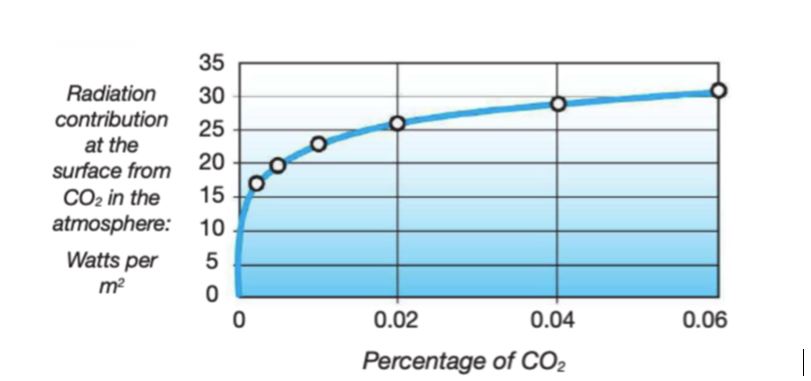
The influence of CO2 as a GHG decreases logarithmically as its atmospheric concentration increases. The first 100ppm (parts per million) of CO2 causes some 80% of the GHG effect, and each increment thereafter, successively less.
A simple analogy is to imagine that you have a black wall that you want to paint white. The first coat of white paint has a major effect on the perceived colour, but the black still shows through. The second coat makes it whiter, but you can still see some faint blackness. After 5 or 6 coats, the wall looks white, and additional coats will not change its appearance. The paint coatings are then “saturated”.
At the current CO2 concentration of approximately 422 ppm, its concentration is on the flatter part of the curve. Further increases in CO2 emissions beyond this point will have minimal effect on the earth’s temperature.
This simplified description just discusses the basic concepts of greenhouse gas physics. However, the earth’s climate and surface temperature also depend on many other powerful factors, such as:
- variations in the Sun’s luminosity and spectral distribution
- variations in cosmic rays
- variations in the Earth’s magnetic field
- variations in cloud cover
- variations in the Tropopause Inversion Layer
- the amount of heat stored in, released from, or transported by the oceans and their currents
- cyclical local changes in ocean currents (El Nino, La Nina, AMO, etc.)
- several feedback mechanisms (both positive and negative)
- volcanic eruptions. (On January 15, 2022, the Hunga Tonga submerged eruption increased atmospheric water vapour, the major greenhouse gas, by approximately 10%)
- long term variations in the orbital parameters of the earth and the planets (leading to Milankovitch cycles)
As we can see from the above discussion, variations in the atmospheric CO2 concentrations are not the major factor in changes to the earth’s climate, and CO2‘s incremental effect is becoming vastly reduced as its levels increase.
Canada’s climate policies need to recognize that efforts to slow the rate of global warming by reducing Canada’s CO2 emissions are futile, and our limited financial resources need to be devoted to areas where they will do the most good.
Discover more from Andrew's Views
Subscribe to get the latest posts sent to your email.
Categories: Climate Change, climate crisis, Science, Uncategorized
 Andrew's Views
Logarithmic curves don’t show saturation. Saturation means the value of the function approaches a limit asymptotically which it can never reach, only approach at infinity (and never exceed.) In contrast, a logarithmic function increases without limit. Each doubling produces the same absolute increase, and you always get that increase. Where people get confused is that both saturation curves and logarithmic curves show continuously decreasing slope and they think logarithmic = saturation but that’s not correct. There is no level of CO2 above which warming does not increase, as long as the curve is logarithmic. The atmosphere of Venus contains much more CO2 that the earth has, and Venus is much hotter. (It is also closer to the sun, of course.) But if the amount of CO2 in Venus’s atmosphere increased, Venus would still get even hotter, logarithmically.
The idea that CO2 “saturates” and therefore we don’t have to worry about it is disinformation that has been debunked long ago. Please don’t use mathematical terms in ways that show you don’t understand them.
LikeLike
I would not normally post a comment like this because its author remained unnamed and the tone of the comment is rather rude. I particularly dislike language like “disinformation” and “debunked” as this is all too frequent in Internet squabbling. It is tantamount to saying that your opinion is just BS and I won’t even take the time and trouble to explain why I disagree with it. With that said, I will let Roger Palmer provide his answer to this comment.
LikeLike
Notice that in the long list of factors affecting climate only CO2 can in any way be related to human collective guilt. ERGO the mad singular focus on CO2, the washing away of sins by wasting $trillions, and centralizing of enormous power in the hands of those who believe they are our redeemers.
LikeLike
Reply from Roger Palmer:
Thanks for the comment. The title of the post was “Simplified explanation ….”, and therefore it was worded in a way that would be more accessible to readers with little scientific background. The article does not say that the greenhouse effect due to CO2 is saturated, it states that the effect is “…said to be nearing saturation.” This is a simplistic way of using terminology which will indicate the shape of a rising curve whose slope is continually decreasing. The incremental warming caused by further increases in CO2 concentration will be less than they were at lower initial concentrations.
The relationship of radiation absorbance to gas concentration is described in the Beer-Lambert Law. A thorough analysis of the sensitivity of global warming to the concentration of greenhouse gases can be found in a 2020 paper by W.A. van Wijngaarden of York University and W. Happer of Princeton University entitled: “Dependence of Earth’s Thermal Radiation on Five Most Abundant Greenhouse Gases”. “
LikeLike
Thank you Roger Palmer for your explanation. Have you shared this with Friends of Science for distribution on their website and contact list? I am forwarding this to my MP John Barlow for distribution to his Conservative colleagues. Your closing comment is so relevant to the debate about Climate Change. Maybe Mark Carney would be enlightened by your simplified explanation. T.S.
>
LikeLike
Thanks Ted, I have now shared this post with Friends of Science. And thanks for forwarding this to your MP.
LikeLike
It sure would be convenient if the effect of greenhouse gases was limited past a certain point of accumulation, unfortunately science does not support that view. A very readable article explaining why a “saturation” theory of CO2 energy absorption/ transmission cannot be relied upon to allow us to avoid dealing with the problem is available at:
https://skepticalscience.com/saturated-co2-effect.htm
LikeLike
This is essentially a semantic quibble. No one is advocating something called a “saturation theory”. I agree that saturation has not been achieved. For that theory the concentration must be at 100%, which is never going to be achieved even if it reaches 99.999%.
The colloquial term “saturation effect” better describes that approximation, and explains how the effect of further increases in concentration will have less of an effect on climate. This is analogous to the economic term “diminishing returns to scale”.
So let’s agree not to use the expression “CO2 is saturated” but instead, use the term “saturation effect” to describe the reduced effect of further increases in concentration. The transmission of electromagnetic energy (light, photons, etc.) through a gas is subject to the Beer-Lambert Law.: https://en.wikipedia.org/wiki/Beer%E2%80%93Lambert_law.
The video link takes off-the-cuff remarks by Professor William Happer when he was interviewed by a layperson, and claims that he therefore is incompetent. He is an eminent Princeton professor and also, co-author of a scientific paper that thoroughly addresses the topic, co-authored with York University Professor van Wijngaarden: “Dependence of Earth’s Thermal Radiation on Five Most
Abundant Greenhouse Gases” at: https://wvanwijngaarden.info.yorku.ca/files/2020/12/WThermal-Radiationf.pdf?x45936
In a more recent paper, W. R. Lindzen, W. Happer and W. A. van Wijngaarden, Atmospheric and Oceanic Physics arXiv: 2406.07392 (2024), the authors write:
“Using feedback-free estimates of the warming by increased atmospheric carbon dioxide (CO2) and observed rates of increase, we estimate that if the United States eliminated net CO2 emissions by the year 2050, this would avert a warming of 0.0084 C, which is below our ability to accurately measure. If the entire world forced net zero CO2 emissions by the year 2050, a warming of only 0.070 C would be averted. If one assumes that the warming is a factor of 4 larger because of positive feedbacks, as asserted by the Intergovernmental Panel on Climate Change (IPCC), the warming averted by a net zero US policy would still be very small, 0.034 C. For worldwide net zero emissions by 2050 and the 4-times larger IPCC climate sensitivity, the averted warming would be 0.28 C.”
What happened to the IPCC estimate of 1.5 or 2.0 C?
LikeLike